The Workshop Mistake That Became Wall Street's Secret Language
The Accidental Pattern
In the cramped workshops of 19th-century London's Savile Row, tailors faced a constant challenge: keeping track of measurements on dark wool fabric. Working by candlelight and gaslight, they needed a way to mark where cuts should be made and seams should fall. Their solution was elegantly practical—thin lines of white chalk drawn along the grain of the fabric to guide their work.
These weren't decorative elements. They were purely functional marks, like a carpenter's pencil lines on wood. The chalk was supposed to brush off once the cutting and initial construction were complete, leaving behind a clean, unmarked garment. But sometimes, especially on certain weaves and in humid conditions, those chalk lines would set into the fabric just enough to remain visible as faint white stripes.
What happened next was a perfect storm of accident, economics, and social climbing that would eventually put the same pattern on the backs of American financial titans.
When Mistakes Became Fashion
Initially, suits with visible chalk marks were considered defective. Customers who received them would complain, and tailors would offer discounts or remakes. But by the 1840s, something interesting was happening in London's financial district. Clerks and junior bankers who couldn't afford perfect bespoke suits were buying these "flawed" garments at reduced prices.
The irony was delicious: the very marks that indicated a suit was imperfect began to signal that it was bespoke rather than ready-made. Off-the-rack clothing didn't have chalk marks because it wasn't individually measured and cut. Only custom work showed those telltale lines. What started as a workshop error became a badge of authenticity.
Savile Row tailors, ever attuned to their clients' psychology, began to notice that some customers specifically requested suits with "the chalk marks left in." By the 1860s, deliberate pinstripes were being woven into fabric rather than accidentally left behind. The mistake had become a feature.
Crossing the Atlantic
American business culture in the late 1800s was obsessed with European sophistication, particularly anything that smacked of British financial expertise. When American entrepreneurs traveled to London for business, they returned wearing pinstriped suits that immediately marked them as internationally connected.
The pattern arrived in New York just as American finance was consolidating into the concentrated power structure we recognize today. The robber barons and railroad magnates of the Gilded Age needed a uniform that separated them from both the working class and the old landed gentry. Pinstripes offered the perfect solution: European enough to signal sophistication, distinctive enough to create group identity, and expensive enough to maintain exclusivity.
Wall Street's adoption of pinstripes wasn't just about fashion—it was about creating a visual language of authority. The vertical lines created an illusion of height and slimness that conveyed control and discipline. The pattern was subtle enough to seem understated while being distinctive enough to be immediately recognizable.
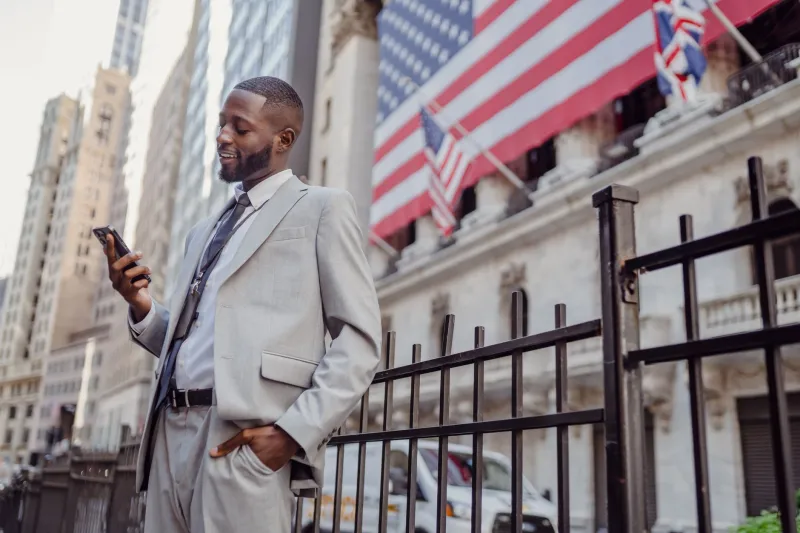
 Photo: Wall Street, via www.genealogyintime.com
The Psychology of Power Dressing
By the early 1900s, pinstripes had developed an almost supernatural association with financial acumen. The pattern didn't just indicate wealth—it suggested the specific type of intelligence required to generate and manage wealth. Wearing pinstripes became a way of claiming membership in an exclusive club of people who understood money.
This psychological power was carefully cultivated. Banking houses began requiring pinstriped suits as part of their dress codes. Investment firms used the pattern in their advertising and office decor. The association became so strong that editorial cartoonists began using pinstripes as shorthand for Wall Street excess and corporate power.
The pattern's vertical emphasis played into deeper psychological associations with authority and stability. Horizontal patterns suggest relaxation and informality, while vertical patterns convey seriousness and upward momentum. In a culture increasingly focused on economic growth and social mobility, pinstripes became the visual embodiment of ambition.
The Democratic Dictator
What makes the pinstripe story particularly American is how a symbol of exclusivity eventually became accessible to almost everyone. By the 1950s, department stores were selling pinstriped suits to middle managers and insurance salesmen. The pattern that once marked the financial elite had trickled down to anyone who wanted to project authority and competence.
This democratization didn't diminish the pattern's power—it amplified it. Suddenly, every man in America could dress like a Wall Street executive, at least from a distance. The pinstripe became a kind of costume that allowed ordinary workers to participate in the theater of financial authority.
Television and movies reinforced these associations. Every fictional banker, every movie executive, every character who was supposed to represent corporate power wore pinstripes. The pattern became so embedded in American visual culture that it transcended fashion to become a form of communication.
The Enduring Code
Today, even as business dress codes have relaxed dramatically, pinstripes retain their psychological impact. Tech billionaires might wear hoodies, but when they need to testify before Congress or address shareholders, many still reach for pinstripes. The pattern has become a kind of formal business uniform that signals seriousness and competence across industries.
The original chalk marks that London tailors drew on fabric were meant to be temporary—functional marks that would disappear once their purpose was served. Instead, they became one of the most enduring symbols in American business culture. Those accidental lines now carry more cultural weight than almost any other pattern in fashion history.
Every pinstriped suit walking through downtown Manhattan or sitting in a corporate boardroom carries the ghost of those 19th-century workshop accidents. A tailor's practical solution for working in dim light became the unofficial uniform of American capitalism. Sometimes the most powerful symbols emerge not from careful design but from the happy accidents of craftsmen just trying to do their jobs better.
In a way, it's the perfect metaphor for American business culture itself: taking someone else's mistake, recognizing its potential, and turning it into a source of power and profit that lasts for generations.