Why Your Favorite Colors Were Born From a Wartime Crisis Nobody Talks About

The bold, saturated colors that fill American retail stores today — the electric blues, the hot pinks, the vivid yellows that line the racks every spring — feel like they've always been there. They feel natural, obvious, like of course clothes come in these colors. But they don't come from nowhere. They come from a specific crisis, a specific scramble, and a specific moment when the American clothing industry had no good options and had to invent new ones.
They come, in short, from a war.
Before the War, Colors Were Quiet
To understand what happened, you have to understand what American clothing actually looked like before World War II. The dominant palette of respectable dress — for both men and women — was restrained almost to the point of severity. Navy. Charcoal. Ivory. Muted greens and dusty browns. The occasional burgundy if you were feeling adventurous. Bright color existed at the margins: in children's clothing, in theatrical costume, in the dress of communities that mainstream tastemakers politely ignored.
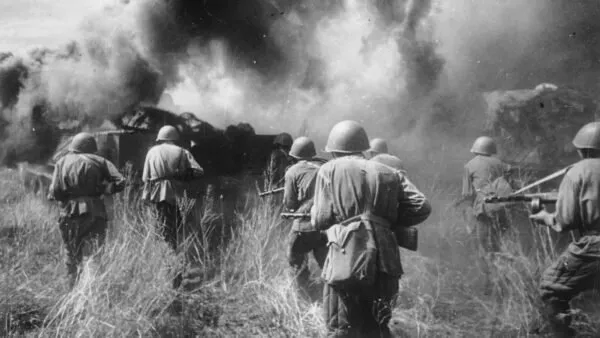 Photo: World War II, via thecconnects.com
This wasn't simply a matter of taste. It was partly technical. The dyes used to produce truly vivid, stable color in fabric — particularly the synthetic aniline dyes developed in the mid-19th century — were expensive, often difficult to work with, and prone to fading. Bright colors also carried social baggage. They read as vulgar, as lower-class, as the kind of thing worn by people who didn't know better. Muted was sophisticated. Bright was suspect.
That was the world American fashion inhabited until 1941.
The Dye Shortage Nobody Remembers
When the United States entered World War II, the federal government moved quickly to redirect industrial resources toward the war effort. Among the casualties of this mobilization was the civilian dye supply. The synthetic dyes used in textile manufacturing were derived from many of the same chemical processes used to produce military materials — explosives, pharmaceuticals, treated fabrics for uniforms and equipment. The War Production Board began rationing and redirecting dye supplies away from civilian clothing manufacturers.
This created a genuine crisis for an industry that had been operating with a fairly comfortable, established chemistry. The colors manufacturers knew how to make reliably — the navies, the charcoals, the muted tones that respectable American clothing required — were suddenly difficult or impossible to produce in the quantities needed.
So manufacturers started experimenting.
The Accidental Palette
The synthetic dye alternatives that became available during the war years had different chemical properties than what manufacturers were used to. They bonded differently to fibers. They behaved unpredictably during processing. And they produced colors that nobody had been deliberately trying to make — colors that were brighter, more saturated, more visually aggressive than anything that had previously appeared in mainstream American retail.
Some of these results were genuinely surprising to the chemists producing them. A formula intended to approximate a familiar navy could come out closer to a vivid cobalt. Attempts at standard khaki could yield something closer to a sharp mustard yellow. The palette that emerged from wartime chemical improvisation wasn't designed. It was discovered — almost by accident, almost against the industry's better instincts.
At first, manufacturers were uncertain what to do with these results. But wartime consumers didn't have the luxury of waiting for the old colors to come back. They bought what was available.
The Postwar Collision
Here is where the story gets genuinely interesting. The war ended in 1945, and America came out of it with a specific emotional temperature: relief, optimism, an almost desperate appetite for everything that rationing and anxiety had suppressed. People wanted abundance. They wanted novelty. They wanted visible proof that the gray years were over.
The clothing industry, still working through its wartime dye experiments and finding them increasingly profitable, was ready to offer exactly that. The bright, saturated colors that had been an accident of chemical necessity suddenly looked like the perfect visual language for postwar American feeling. Vivid color wasn't vulgar anymore. It was modern. It was free. It was the opposite of khaki and olive drab and every other muted shade that had defined four years of sacrifice.
The 1950s explosion of color in American fashion — the turquoise kitchen appliances, the pink poodle skirts, the electric-yellow sportswear — is usually talked about as a cultural phenomenon, a reflection of postwar optimism and suburban prosperity. All of that is true. But underneath the cultural story is a more prosaic one: the colors were available because wartime chemistry had accidentally made them available, and the industry had learned how to produce them at scale.
The Permanent Rewiring
What the wartime dye shortage actually did, in the long run, was break the social code that had kept bright color out of respectable American dress for generations. Once those colors were in circulation — once ordinary Americans had worn them, bought them, associated them with joy and abundance and the end of hard times — the old rules about muted sophistication lost their grip.
By the 1960s, the counterculture would take bright color even further, turning it into an explicit statement about rejecting the establishment. By the 1980s, neon would become its own cultural moment. Today, American retail operates in a color environment that would have seemed genuinely shocking to a clothing buyer from 1940.
None of it was planned. A government board needed to redirect chemical supplies to win a war. Manufacturers improvised. Consumers adapted. And somewhere in that chain of necessity and accident, the American relationship with color changed permanently.
The bold palette in your closet right now has a longer and stranger history than it looks.