The Glorified Ring of Rubber That Quietly Held American Business Together

There is probably one sitting in your junk drawer right now. Maybe a few. Tangled together, slightly sticky, possibly older than your last job. The rubber band is so ordinary, so cheap, so everywhere that nobody ever stops to ask how it got there.
That's exactly what makes its story interesting.
A British Engineer and a Very Modest Patent
In March of 1845, a man named Stephen Perry filed a patent in London for a device made of vulcanized rubber formed into a ring. His stated purpose was practical and unglamorous: holding together papers and envelopes. Perry worked for a rubber manufacturing company called Messrs. Perry and Co., and the invention was essentially a commercial byproduct of a bigger revolution happening in materials science.
 Photo: Stephen Perry, via igormiranda.com.br
That bigger revolution belonged to Charles Goodyear, the American inventor who had discovered vulcanization just a few years earlier — a process that treated raw rubber with sulfur and heat to make it stable, elastic, and durable. Before Goodyear cracked that formula, natural rubber was a nightmare material. It melted in summer heat and cracked in winter cold. After vulcanization, it could stretch, snap back, and hold its shape across seasons.
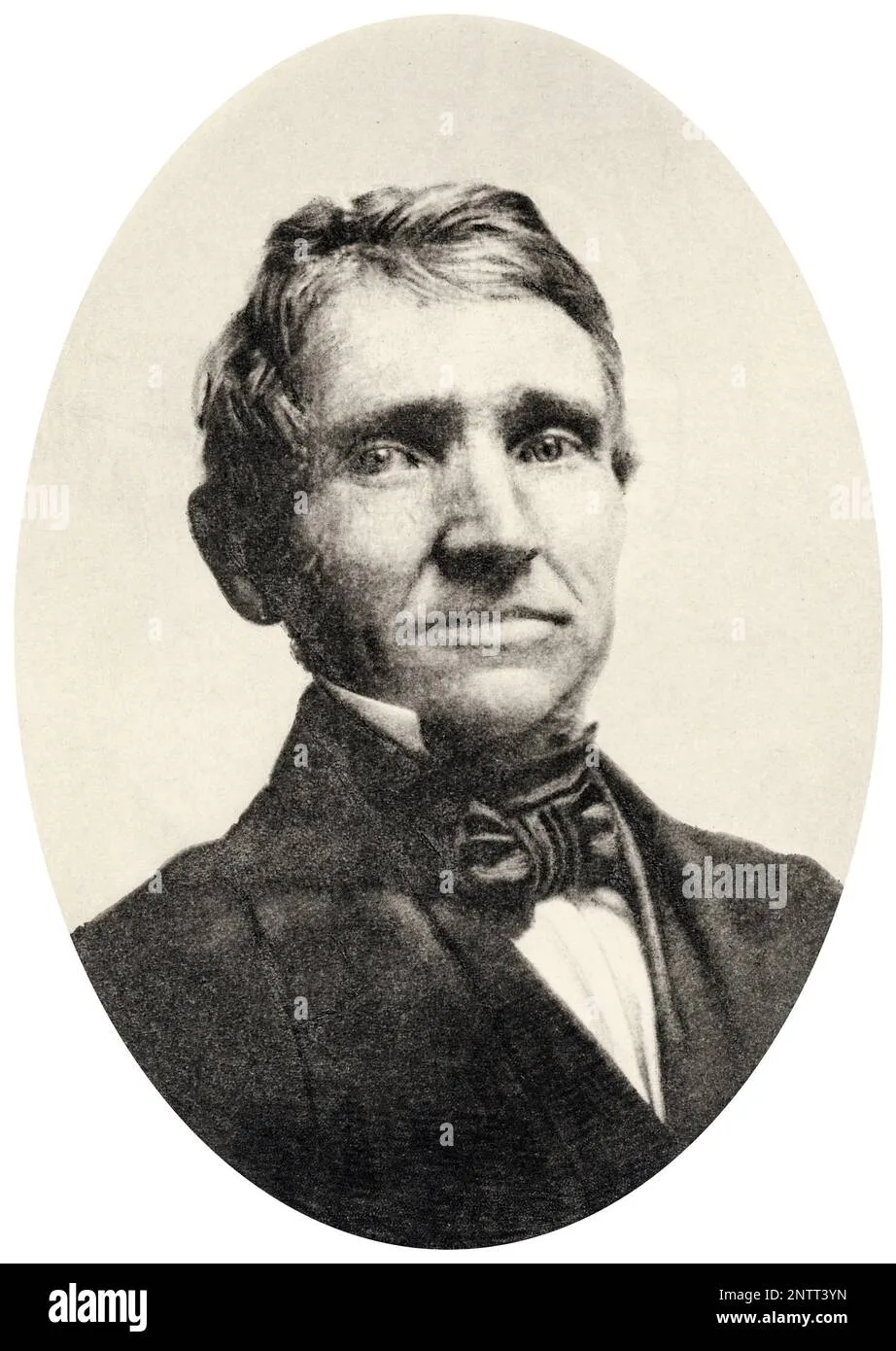 Photo: Charles Goodyear, via c8.alamy.com
Perry saw the commercial opportunity and ran with it. His rubber bands were real, functional, and patented. And then, for a while, almost nothing happened.
The Problem Nobody Had Officially Named
The rubber band's early decades were quiet. It existed. It worked. People used it when they had one. But it hadn't yet found the cultural moment that would turn a curiosity into a necessity.
That moment came from the peculiar explosion of American paperwork in the late 19th century.
As the United States industrialized and its cities grew, commerce became increasingly bureaucratic. Businesses generated correspondence. Banks generated ledgers. Government offices generated forms. The railroad industry alone produced a staggering volume of documentation. All of it needed to be sorted, bundled, stored, and retrieved — and wooden crates weren't going to cut it at a desk.
The rubber band stepped into a gap that nobody had drawn a box around yet. It wasn't solving a problem that had been formally identified. It was solving about forty problems at once: bundling invoices, keeping currency stacks together, organizing loose documents, securing rolled blueprints, marking pages in ledgers. It was the Swiss Army knife of the office supply cabinet, except it cost almost nothing and fit in a pocket.
American manufacturers started producing rubber bands domestically in significant quantities by the 1870s and 1880s, and the price kept dropping as production scaled. By the turn of the century, they were showing up in offices, post offices, grocery back rooms, and household kitchens across the country.
The Mail-Order Catalogs Changed Everything
If one industry deserves credit for cementing the rubber band's place in American life, it's the mail-order catalog business.
Companies like Sears, Roebuck and Co. and Montgomery Ward were, by the 1890s, shipping enormous volumes of bundled catalogs, order forms, and packaged goods across the country. Their warehouse operations required fast, cheap, reliable ways to keep items grouped and organized at scale. Rubber bands were perfect. They were lightweight, didn't add shipping cost, and could hold together everything from fabric swatches to stacks of receipts.
Those same catalogs were also selling rubber bands directly to American households, often in small assorted bags for a few cents. The catalog economy essentially introduced the rubber band to rural and small-town America — people who might never have walked past an urban office supply shop suddenly had a reason to keep a handful in the kitchen drawer.
By the early 20th century, the rubber band had become what historians of material culture sometimes call an "invisible infrastructure" item: something so embedded in daily practice that its absence would be immediately felt, but whose presence goes completely unnoticed.
The Alliance Rubber Company and the American Standard
In 1923, a company called Alliance Rubber was founded in Alliance, Ohio, and it would go on to become one of the dominant forces in American rubber band manufacturing. Alliance didn't invent anything new about the rubber band itself — but it industrialized the product at a scale that made it genuinely ubiquitous.
 Photo: Alliance, Ohio, via c8.alamy.com
The company eventually became the supplier for the United States Postal Service, which turned out to be one of the most consequential distribution deals in the history of office supplies. Letter carriers across the country began arriving at homes and businesses wrapped in rubber bands — and those rubber bands stayed. They accumulated in drawers, on doorknobs, in kitchen bowls. The USPS, without meaning to, became one of the most effective rubber band distribution networks in history.
By mid-century, the average American household had rubber bands without ever having bought them. They just appeared, delivered alongside the mail, a small elastic gift from the postal system.
What a Rubber Band Actually Taught Us
There's a reason the rubber band endures in an age of binder clips, zip ties, velcro straps, and digital filing systems. It's not nostalgia. It's that the rubber band does something none of those alternatives quite replicate: it applies gentle, even pressure across irregular shapes, it's instantly removable without tools, and it costs so little that nobody minds losing one.
It also never needed a manual. You understood it the first time you picked one up.
That frictionless usability is part of what made it so commercially powerful. American business culture in the 19th and 20th centuries was constantly searching for tools that could be adopted without training, scaled without complexity, and discarded without guilt. The rubber band checked every box.
Stephen Perry filed that 1845 patent thinking about paper and envelopes. He could not have imagined that his simple loop of vulcanized rubber would quietly hold together the receipts, the bundles, the produce bags, the rolled posters, and the junk drawer chaos of an entire nation for the next 180 years.
Some inventions change the world loudly. This one just stretched around it.