The Rigged Game That Rewired How Americans Think About Wanting
The Science of Almost Winning
Step right up and witness the birth of modern consumer psychology, disguised as innocent fun. Those carnival games that have frustrated millions of Americans over the past century weren't designed to be fair—they were engineered to be almost winnable. And in that careful calibration between hope and disappointment, traveling carnival operators accidentally discovered something that would reshape how Americans think about desire, effort, and reward.
The story begins in the 1890s, when traveling carnivals were figuring out how to separate farmers and factory workers from their hard-earned coins. Early carnival games were straightforward gambling: you either won or lost, quickly and cleanly. But operators noticed something interesting—people got more excited about games where they came close to winning than games where the outcome was immediate and obvious.
The Birth of Manufactured Frustration
Carnival psychology wasn't accidental. Operators studied their customers with the intensity of laboratory researchers. They noticed that a player who lost immediately would walk away annoyed but not necessarily hooked. But a player who knocked down two bottles out of three, or landed a ring just barely off the peg, would reach for their wallet again. And again.
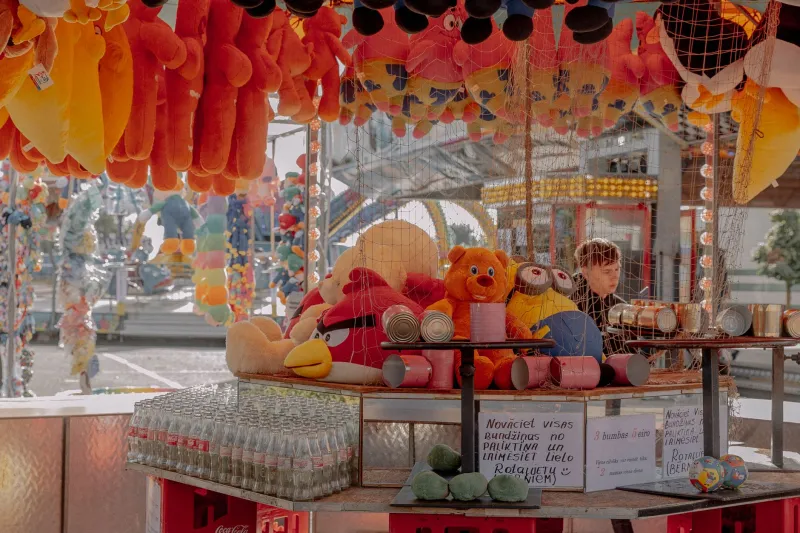
The genius was in the prize structure. Those enormous stuffed animals hanging overhead weren't just rewards—they were psychological anchors. The teddy bear had to be big enough to see from across the midway, cuddly enough to trigger protective instincts, and valuable enough to justify the accumulating cost of multiple attempts. The size mattered because it created what psychologists now call the "endowment effect"—people started mentally owning that prize before they actually won it.
Operators fine-tuned everything: the weight of the baseballs (slightly heavier than normal), the spacing of the milk bottles (just wide enough to let balls slip through), the tension on the basketball hoops (tight enough to reject all but perfect shots). Every element was calibrated to create near-misses that felt like progress rather than failure.
The Emotional Economics of Effort
What carnival operators discovered was revolutionary: people don't just want things because they're valuable—they want things more when they've invested effort in trying to get them. This wasn't about the actual monetary value of a stuffed animal that probably cost fifty cents to manufacture. It was about the psychological value created through struggle.
The carnival game taught Americans a dangerous equation: effort plus money plus time equals deserving. If you threw enough baseballs, spent enough quarters, and tried hard enough, you had somehow earned that prize. The game transformed wanting something into feeling entitled to it based on investment rather than achievement.
This was radically different from how previous generations thought about acquisition. Traditional commerce was straightforward: you needed something, you saved money, you bought it. Carnival games introduced the idea that the process of trying to get something could be more compelling than actually having it.
From Midway to Main Street
By the 1920s, carnival psychology was migrating into mainstream retail. Department stores started offering "chances to win" alongside regular purchases. Catalog companies introduced mystery boxes and surprise elements. Advertisers began emphasizing the effort and dedication required to afford their products rather than just the products themselves.
The breakthrough moment came when retailers realized they could replicate carnival psychology without the actual gambling. Sales events became games: limited-time offers created urgency, "while supplies last" triggered scarcity psychology, and layaway plans allowed customers to invest effort over time before receiving their reward.
Even the physical design of stores began reflecting carnival principles. Products were displayed just out of easy reach, requiring customers to ask for help or make extra effort. Checkout lines were designed with impulse purchases that offered small, immediate rewards for the effort of waiting.
The Digital Carnival
Today's online shopping experience is essentially a sophisticated carnival game. Every element that carnival operators perfected over decades has been digitized and amplified. The "almost sold out" warnings, the countdown timers, the "people who bought this also bought" suggestions—it's all carnival psychology dressed up in algorithms.
Social media platforms have perfected the near-miss mechanic through likes, shares, and viral potential. Every post is essentially a carnival game where you're trying to hit the right combination of timing, content, and luck to win the giant teddy bear of internet fame. The effort invested in crafting the perfect post, the near-misses of posts that get some engagement but don't go viral, the occasional big win that keeps you playing—it's the same psychological framework that carnival operators discovered over a century ago.
E-commerce sites use variable reward schedules that would make carnival operators jealous. Flash sales create time pressure, user reviews create social proof, and "recommended for you" algorithms ensure there's always another prize dangling just within reach.
The Price of Always Almost Winning
The carnival's legacy is a culture that's constantly reaching for prizes that stay just out of reach. Americans now expect acquisition to involve effort, competition, and a element of chance. We're suspicious of things that are too easy to get and attracted to things that require investment beyond their actual value.
This psychology has shaped everything from how we buy houses (bidding wars that drive prices beyond rational value) to how we choose restaurants (the harder it is to get a reservation, the more we want it). The carnival taught us to confuse difficulty with desirability, and that lesson has become deeply embedded in American consumer culture.
Those traveling carnivals that rolled through small towns every summer weren't just providing entertainment—they were conducting the largest psychology experiment in American history. And we're all still playing their game, reaching for prizes that somehow always seem to require just one more try.