How a Flimsy Paper Box From a Michigan Health Clinic Ended Up Running the American Grocery Store
Walk into any American grocery store and look at the cereal aisle. Rows of tall, brightly colored boxes stacked face-forward, each one a small billboard competing for the same three seconds of your attention. It's so familiar it barely registers.
But that shelf — and the entire logic of how it's organized — exists because of a cost-cutting decision made in a Michigan sanitarium in the 1890s. And the box itself, the folded paperboard container that now holds everything from pasta to granola bars to dog treats, was once considered so flimsy and unserious that the packaging industry barely acknowledged it.
Before the Box, There Was the Barrel
For most of the 19th century, American grocery stores did not look anything like they do today. Goods arrived in bulk — flour in sacks, crackers in barrels, coffee in large tins, dried goods in wooden crates. The grocer measured, scooped, and wrapped individual portions for each customer. Shopping was a transaction between a person and a merchant, not between a person and a package.
This system worked, but it had real problems. Bulk goods were exposed to air, pests, and contamination. Quality varied from barrel to barrel. And there was no way for a manufacturer to communicate directly with the customer — no brand name on the product, no story, no visual identity. The grocer was the brand.
The folded paperboard box existed during this era, but barely. It had been patented in various forms since the 1850s, and a Brooklyn printer named Robert Gair accidentally mass-produced the first pre-cut, pre-folded paperboard box in 1879 when a metal pin in his printing press slipped and cut through an entire run of seed bags. He looked at the mistake, recognized the efficiency, and pivoted to box manufacturing.
Gair's boxes were real. They were cheap to produce. But the packaging industry largely dismissed them. Wood and tin were serious materials. Paper was for wrapping fish.
The Sanitarium in Battle Creek
In the late 1800s, Battle Creek, Michigan, was the unlikely center of America's health food movement. Dr. John Harvey Kellogg ran the Battle Creek Sanitarium — a sprawling wellness resort where patients were treated with exercise, vegetarian diets, and a deep suspicion of meat and stimulants. Kellogg believed that processed grain foods were gentler on the digestive system than the heavy, meat-heavy American diet of the era, and he spent years experimenting with ways to make grains more palatable.
 Photo: Battle Creek Sanitarium, via img.atlasobscura.com
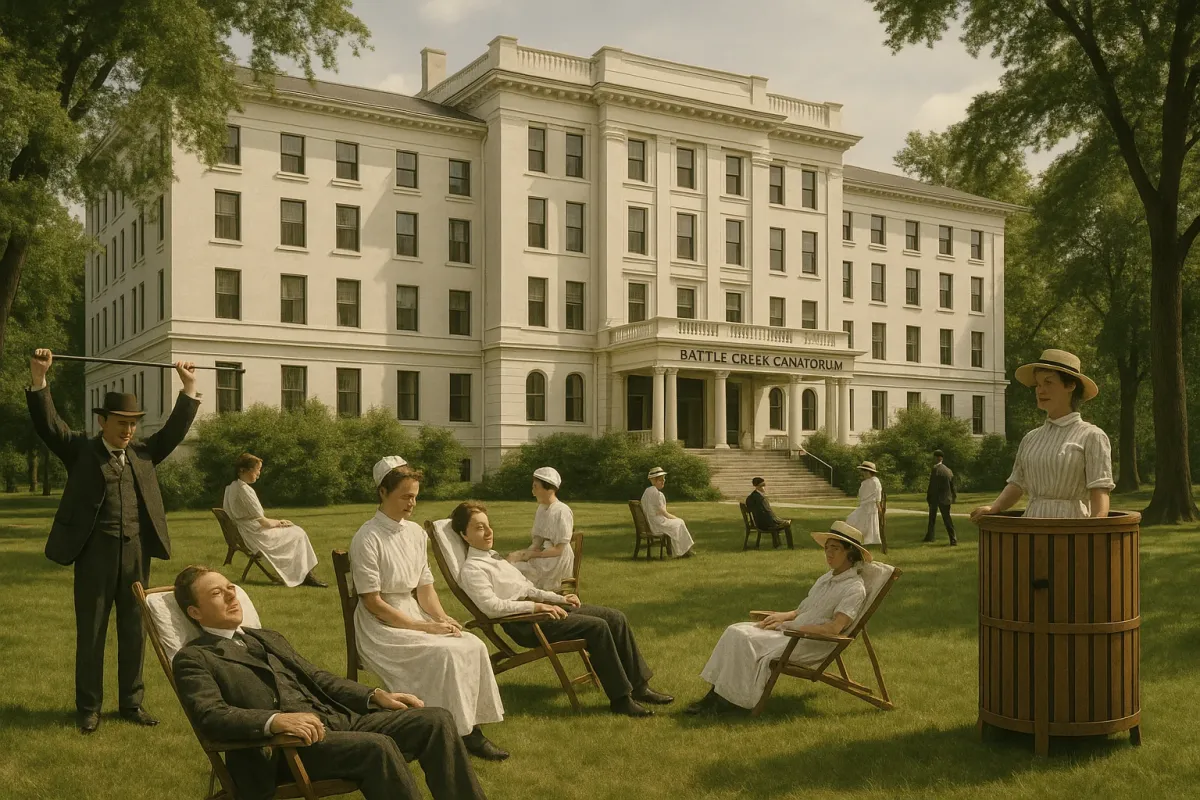 Photo: Dr. John Harvey Kellogg, via historic-times.com
 Photo: Battle Creek, Michigan, via i.pinimg.com
In 1894, Kellogg and his brother Will Keith Kellogg accidentally left a batch of cooked wheat sitting out overnight. When they ran it through their rollers the next morning, it came out in thin, separate flakes instead of a solid sheet. They baked the flakes and served them to patients. The response was enthusiastic.
The Kellogg brothers had invented the breakfast cereal flake. And now they needed to figure out how to sell it.
The Box as a Business Decision
Early cereal was sold in plain, utilitarian packaging — paper bags, simple cardboard tubes, modest containers designed to get the product from factory to table without making any particular impression. The emphasis was on the health claims, not the container.
That changed when Will Keith Kellogg, the more commercially minded of the two brothers, broke from John Harvey and founded the Battle Creek Toasted Corn Flake Company in 1906. Will understood something his brother didn't: selling food at scale meant selling an idea, not just a product. And the package was where that idea had to live.
Will adopted the folded paperboard box and turned it into a marketing platform. He printed his signature on the box as a quality guarantee — one of the first uses of a founder's personal brand as a consumer trust signal. He added messaging, imagery, and eventually premium offers and coupons printed directly on the packaging. The box wasn't just a container. It was a salesperson that lived in the customer's home.
C.W. Post, a former Kellogg sanitarium patient who had started his own cereal company in Battle Creek, took the same approach and pushed it further. Post's Grape-Nuts boxes featured dense text explaining the health benefits of the product, essentially turning the package into a pamphlet. Both companies were discovering, at the same time, that the box was the cheapest advertising space they would ever buy — because the customer had already paid for it.
The Grocery Store Reorganizes Itself
The success of boxed cereal had a cascading effect on how American grocery stores were designed and stocked.
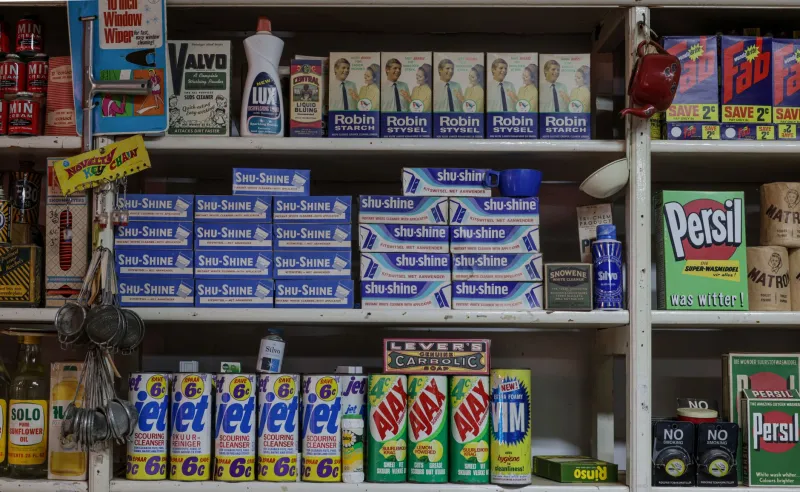
Before standardized packaging, stores were organized around the grocer's workflow — bulk goods stored where they were easy to access and portion. Once manufacturers started shipping uniform boxes of consistent size, stores could stack products on open shelves, face-forward, accessible to customers without staff assistance. This was the precondition for the self-service grocery store, which began appearing in the 1910s and transformed into the modern supermarket by the 1930s and 1940s.
The folded paperboard box made self-service retail physically possible. You couldn't stack barrels face-forward on a shelf and let customers browse. You could absolutely do that with boxes.
Kraft, Campbell's, and dozens of other food manufacturers watched the cereal industry and drew the obvious conclusions. By the mid-20th century, the paperboard box had become the default packaging format for American pantry goods — pasta, crackers, cake mixes, rice, oatmeal, cookies. The barrel and the bulk bin retreated to the margins.
The Box as Cultural Object
There's one more thing the cereal box did that's easy to overlook: it created the first mass media experience designed specifically for children at breakfast.
By the 1950s, cereal manufacturers had figured out that kids influenced breakfast purchases, and they began loading their boxes with games, puzzles, prizes, and cartoon characters aimed directly at young readers. The back of a cereal box became a cultural institution — something millions of American children stared at every morning while eating, absorbing brand messaging disguised as entertainment.
Tony the Tiger. Cap'n Crunch. The Trix rabbit. These weren't just mascots. They were the faces of a packaging revolution that had started sixty years earlier with a flimsy paper box that serious people thought wasn't worth taking seriously.
Robert Gair's printing press accident. The Kellogg brothers' forgotten batch of wheat. Will Keith's instinct to sign his name on a cardboard panel.
Somewhere in that chain of small moments, the American grocery store was born.