The Pocket That Wasn't There: How Women's Jeans Were Built to Make You Buy More
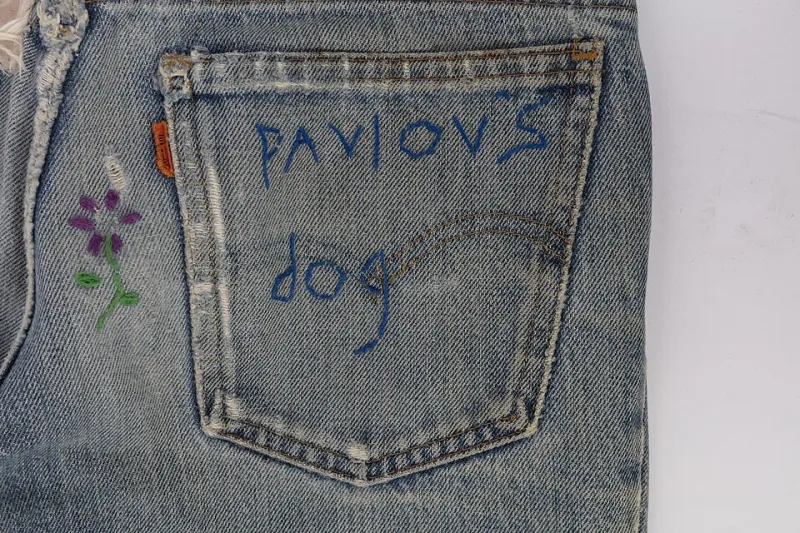
Photo: Levi Strauss, Public domain, via Wikimedia Commons
At some point, probably recently, you've reached into the pocket of your jeans and found nothing. Not nothing like you forgot your phone — nothing like there was never a real pocket there to begin with. Just a shallow decorative flap, stitched shut or barely open, offering the suggestion of storage without any of the actual function.
You probably sighed, maybe muttered something under your breath, and grabbed your purse. Which was, it turns out, exactly what someone was counting on.
The story of the missing pocket in women's clothing is not a tale of oversight. It's a story of deliberate choices, repeated over generations, that quietly reshaped what women were expected to carry — and who they were expected to buy it from.
Pockets Used to Be Personal Property
Before we talk about what was taken away, it helps to know what was there in the first place. For much of the seventeenth and eighteenth centuries, women's pockets weren't sewn into clothing at all. They were separate pouches — tied around the waist beneath skirts, accessible through slits in the fabric — and they were genuinely large. Big enough for a book, a small tool, a collection of household items. They were private, hidden, and entirely functional.
These pockets weren't considered accessories. They were considered personal space. The historian and author Hannah Carlson has noted that the tied pocket was so fundamental to daily life that its loss, when it eventually came, was mourned explicitly in writing. Women noticed.
What happened? Fashion happened — specifically, the silhouette shift that came with Neoclassical style in the late 1700s. As dresses became narrower and more form-fitting, the bulky tied pocket became visually incompatible with the desired line. The solution, rather than redesigning the pocket, was to eliminate it. Women were offered the reticule instead — a small decorative bag carried in the hand. It held almost nothing and announced its presence constantly.
The handbag industry had found its origin story.
Denim Arrived and the Gap Got Wider
When denim workwear emerged in the American West in the mid-1800s, pockets were a core feature. Levi Strauss and Jacob Davis's riveted trousers were built around the needs of miners and laborers who needed to carry tools, coins, and supplies without seams tearing apart under pressure. The pockets were deep, reinforced, and practical.
For men, that standard held. Men's jeans kept their pockets. Women's jeans — when they finally arrived as a mainstream garment in the mid-twentieth century — did not always get the same treatment.
The divergence wasn't immediate or dramatic. It happened gradually, through hundreds of small design decisions made by manufacturers who were optimizing for a particular silhouette. Deep pockets created bulk at the hip. Bulk disrupted the fitted look that women's jeans were being marketed around. The solution, consistently chosen, was to shrink the pocket — or fake it entirely.
The Fake Pocket Is a Specific Design Choice
Here's what makes the fake pocket more than just an aesthetic compromise: it was a choice made at a specific moment in the design process, approved by specific people, and repeated across the industry as a standard practice. It wasn't accidental.
A 2018 analysis by The Pudding, which measured the pocket dimensions of men's and women's jeans across twenty major brands, found that women's front pockets were, on average, 48% shorter and 6.5% narrower than men's. Nearly half of the women's jeans examined couldn't fit a hand past the knuckles. Many featured pockets that were purely decorative — present in appearance, absent in function.
The implication is straightforward. If your jeans can't hold your phone, your wallet, or your keys, you need something else to carry them in. That something else has a name, a price tag, and an entire industry behind it.
The Purse Wasn't Optional — It Was Engineered
The handbag market in the United States generates tens of billions of dollars annually. It is one of the most reliably profitable segments of the fashion industry, supported by a customer base that has been, for generations, trained to accept that carrying a separate bag is simply what women do.
But that acceptance didn't come from nowhere. It was cultivated, in part, by the consistent removal of a functional alternative. When your clothing can't carry your essentials, an accessory stops being optional. It becomes necessary. And necessity, in the fashion industry, is extremely good for business.
This isn't a conspiracy theory — it's a design feedback loop. Manufacturers made pockets smaller because fitted silhouettes sold well. Fitted silhouettes required accessories to compensate. Accessories became a massive revenue category. And the removal of functional pockets became entrenched as a standard, reinforced by decades of consumer behavior built around its absence.
The Backlash Is Getting Louder
Something has shifted in recent years. The fake pocket has become a cultural flashpoint in a way it never quite was before. Social media gave women a platform to document the absurdity — videos of phones falling out of shallow pockets, comparisons of men's and women's jeans held side by side, the now-familiar ritual of a woman showing how little fits in her "pocket" while a man produces his entire life from his.
Some brands have responded. Everlane, Levi's, and a handful of others have made functional pockets a marketing point — which says something about how low the bar had been set. When "actually has pockets" becomes a selling feature, it means the absence of pockets had become so normalized that the presence of them feels like a bonus.
The broader conversation is about more than storage. It's about whose needs get designed for, and whose get designed around. The pocket question is small and specific, but it points toward something larger: the way everyday objects encode assumptions about who they're built to serve.
What a Pocket Actually Means
A pocket is, at its most basic, a place to put things. It's a small promise from your clothing that your hands can be free, that you don't need to track a separate bag, that you can move through the world without managing an accessory.
For most of modern fashion history, that promise was extended to men and withheld from women — not because of some technical limitation, but because someone decided the silhouette mattered more than the function, and the industry followed along.
The next time you reach into a pocket and find nothing, you're not experiencing a design flaw. You're experiencing a design decision. There's a difference — and knowing it changes how the whole thing feels.