The Shoe That Was Built for Silence and Ended Up Screaming
The Shoe That Was Built for Silence and Ended Up Screaming
Somewhere in America right now, someone is standing in line before dawn to buy a pair of shoes. Not because they need shoes — they almost certainly own more shoes than they need — but because these particular shoes are releasing today, in limited quantities, and the resale value will triple by next week. The shoes are probably colorful. They are definitely expensive. And their entire cultural identity is built on being seen.
The original sneaker was designed to be heard by absolutely nobody.
The Suspicious Quiet of the Rubber Sole
In the 1870s and 1880s, rubber was becoming one of the more exciting materials in American manufacturing. Charles Goodyear had figured out how to vulcanize it — making it durable and weather-resistant — back in the 1840s, and by the latter half of the century, rubber was showing up in everything from raincoats to bicycle tires. Shoes were a natural next step.
The first rubber-soled canvas shoes appeared in the U.S. around the 1870s, originally marketed for beach and leisure use under names like "plimsolls." They were light, cheap, and comfortable. They were also, crucially, almost completely silent on hard floors. Leather-soled shoes click and clack with every step. Rubber absorbs the impact. You could walk into a room and nobody would hear you coming.
This was, to the Victorian mind, not a feature. It was a moral hazard.
A Boston newspaper writer named Ambrose Bierce is often credited with popularizing the term "sneaker" in the 1880s, and the name captured exactly what adults feared about the shoe: it allowed its wearer to sneak. Parents worried that children wearing rubber-soled shoes could creep up on people, eavesdrop, and generally operate outside the normal acoustic boundaries of civilized behavior. The sneaker was seen, only half-jokingly, as a tool of deception.
This reputation did not exactly hurt sales among young people.
From the Beach to the Basketball Court
Through the late 1800s and into the early 1900s, rubber-soled shoes became increasingly associated with athletic activity. The grip and flexibility that made them useful for sneaking around also made them excellent for running, jumping, and changing direction quickly. Tennis players adopted them. Basketball, which was invented in 1891, needed a shoe that could handle the demands of a hardwood court, and rubber soles were the obvious answer.
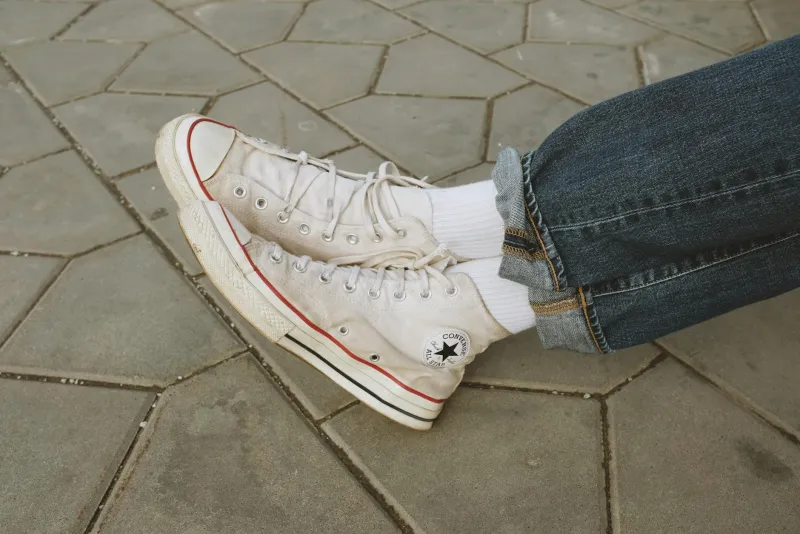
In 1908, a company called Converse Rubber Shoe Company was founded in Malden, Massachusetts. Its early products were standard rubber-soled shoes, but in 1917 the company introduced a canvas basketball shoe that would become one of the most recognizable objects in American cultural history: the Converse All Star.
The shoe got its defining boost in 1921, when a semiprofessional basketball player named Charles "Chuck" Taylor walked into the Converse offices in Chicago and asked for a job. Taylor had been wearing All Stars and had opinions about how they could be improved — specifically, more ankle support and a better fit. Converse hired him, incorporated his feedback into a revised design, and eventually put his signature on the ankle patch. The Chuck Taylor All Star became the standard basketball shoe for decades, worn by players at every level from high school gyms to the Olympics.
For most of the early twentieth century, sneakers were still understood primarily as athletic footwear. You wore them to play sports. You wore other shoes for everything else.
The Moment the Shoe Changed Its Meaning
The cultural shift happened in layers. In the 1950s, the same postwar youth rebellion that turned the T-shirt into a statement garment also reclaimed the sneaker. Teenagers wore canvas sneakers as casual shoes, pairing them with jeans in a combination that their parents found vaguely alarming. The sneaker was cheap, it was comfortable, and it carried a faint whiff of the athletic and the informal — qualities that were exactly right for a generation defining itself against adult convention.
By the 1970s, running had become a mainstream American fitness obsession, and the sneaker industry responded with an explosion of technical innovation. Companies like Nike, founded in 1964 by University of Oregon track coach Bill Bowerman and his former runner Phil Knight, began developing shoes engineered specifically for performance. Bowerman famously poured rubber into his wife's waffle iron to create a new sole pattern with better traction — a story that neatly captures the era's combination of ambition and improvisation.
Nike's 1984 partnership with a rookie basketball player named Michael Jordan produced the Air Jordan 1, a shoe that was initially banned by the NBA for violating uniform color rules. Nike paid Jordan's fines and kept selling the shoe. The controversy was free advertising, and the Air Jordan became the founding document of modern sneaker culture: a shoe defined not just by what it could do on the court, but by what it meant off it.
The Loudest Quiet Shoe in History
Today, the global sneaker market is worth well over $100 billion. Limited-edition releases generate lines that stretch around city blocks. Collectors store shoes they will never wear in climate-controlled rooms. Resale platforms like StockX have turned sneakers into a commodity traded with the same intensity as financial instruments.
The shoe that got its name from being silent has become one of the most conspicuous objects in American consumer culture. It signals age, taste, income, community, and identity all at once. A pair of shoes can tell you more about someone's cultural allegiances than almost any other item they own.
None of which was on the mind of the person who first thought to glue a rubber sole to a canvas shoe and sell it to someone who wanted to move quietly through the world. But that is usually how it goes with the things that end up mattering most — they start as something small and practical, and then the culture gets hold of them and turns them into something else entirely.
Something louder. Something that everyone can see.