The Most Expensive Fidget in History
Walter Hunt was broke. Sitting at his desk in New York City in 1849, the 54-year-old inventor owed a friend fifteen dollars—a decent chunk of money at the time. As he pondered his predicament, Hunt did what many of us do when we're stressed: he started fidgeting with whatever was within reach.
In his case, it was a piece of brass wire about eight inches long.
What happened next took exactly twenty minutes and created one of the most universally useful objects in human history. Hunt twisted the wire, bent it into a spring at one end, and fashioned a clasp at the other that would keep the sharp point safely enclosed. He'd just invented the safety pin.
More importantly for his immediate problem, he'd also invented his way out of debt. Hunt sold the patent rights for $400 to W.R. Grace and Company, paid back his friend, pocketed the difference, and moved on with his life.
He had no idea he'd just given away a fortune.
Before the Safety Pin: A World of Dangerous Fasteners
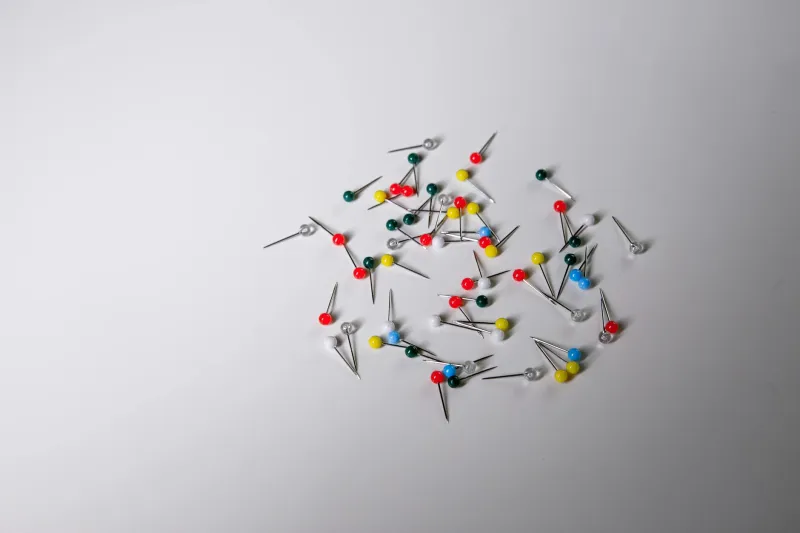
To understand why Hunt's twenty-minute creation was revolutionary, you have to picture what people were dealing with before 1849. Clothing was held together by straight pins—sharp, uncovered pieces of metal that had an annoying habit of stabbing whoever wore them.
Women's fashion was particularly treacherous. Victorian dresses required dozens of pins to secure layers of fabric, petticoats, and bustles. Getting dressed was like navigating a minefield, and mothers lived in constant fear of their children getting hurt by loose pins around the house.
Tailors and seamstresses worked with bleeding fingers. Laundresses dreaded washing day because forgotten pins would poke through wet fabric. Even men weren't safe—their shirts, lacking buttons in many places, relied on straight pins that would work loose throughout the day.
Hunt's enclosed design solved all of these problems at once. The spring mechanism kept the pin securely fastened, while the guard protected everyone from the sharp point. It was so obviously better than what came before that it spread across America within months.
The Patent That Made Everyone Rich (Except the Inventor)
W.R. Grace and Company knew exactly what they'd bought from Hunt. They immediately began mass-producing safety pins and watched the profits roll in. Within a decade, they were manufacturing millions of pins annually and shipping them worldwide.
The safety pin became essential to American life almost overnight. Mothers used them to secure diapers (this was sixty years before disposable diapers with built-in fasteners). Tailors abandoned straight pins entirely. The fashion industry embraced the safety pin as both a practical tool and, eventually, a design element.
Meanwhile, Hunt continued inventing other things—he created an early sewing machine, a streetcar bell, and even a repeating rifle. But none of his other inventions came close to the cultural impact of that twenty-minute wire-twisting session.
By the time Hunt died in 1859, safety pins had become so commonplace that most people couldn't imagine life without them. The man who invented them had made $385 in profit (after paying back his debt). The company that bought his patent had made millions.
From Necessity to Symbol: The Safety Pin's Second Life
The safety pin's story didn't end with Victorian fashion. Throughout the 20th century, it kept finding new purposes and meanings that Hunt never could have predicted.
During World War II, safety pins became symbols of resistance in Nazi-occupied territories. Norwegians wore them on their lapels as a subtle sign of solidarity—small enough to avoid suspicion, but meaningful to those who understood.
In the 1970s, punk rockers in London and New York adopted safety pins as fashion statements, piercing them through clothing, skin, and hair. What had been a symbol of domestic safety became a badge of rebellion. The Sex Pistols and The Ramones made safety pins as iconic to their look as leather jackets and ripped jeans.
Today, safety pins serve dozens of purposes Hunt never imagined. They're emergency zipper pulls, phone SIM card ejectors, and jewelry clasps. After 9/11, wearing a safety pin became a quiet way to signal support for immigrants and marginalized communities.
The Lesson of the Twenty-Minute Million
Walter Hunt's story illustrates something fascinating about innovation: the most transformative inventions often come from the most ordinary moments. Hunt wasn't trying to revolutionize fashion or solve a global problem. He was just a guy who needed fifteen bucks, fidgeting with whatever was on his desk.
The safety pin's success also reveals how practical solutions can transcend their original purpose. Hunt designed a better fastener, but he accidentally created a cultural icon that would carry different meanings for different generations.
Most tellingly, Hunt's decision to sell his patent immediately shows how impossible it is to predict which innovations will matter. He saw a quick solution to his debt problem. He couldn't have foreseen that his twenty-minute sketch would still be in every junk drawer, sewing kit, and first aid box more than 170 years later.
Every time you reach for a safety pin to fix a broken zipper or secure a loose button, you're using Walter Hunt's anxiety fidget. The man who twisted wire while worrying about fifteen dollars created something that billions of people now take for granted.
Not bad for twenty minutes of work—even if he never got to enjoy the profits.